Curran Glass: Experts in Hand Beveled Glass
In glass, there are few things more stunning that a hand-beveled leaded panel sparkling in the sun, throwing rainbows around a room. We make bevels by hand in our studio, on restored production hand-beveling equipment. You won’t find those run-of-the-mill “bevel clusters” here.
Hand beveling is a painstaking, time-consuming process, starting from roughing out the pieces on the diamond (or cast iron with emery) wheel and proceeding through stone wheel smoothing, to cork and pumice, to a final polish on the felt wheel with cerium oxide.
Whenever we can, we bevel old plate glass salvaged from antique mirrors that have been stripped of their silvering. We’ve found that this glass has much better refractory qualities than new, and it’s softer because it contains less iron than the glass made today. (Iron is what gives new glass its blue-green tint.) This softness makes the old glass a joy to polish. Because old plate glass is normally 5/16” thick, our standard 1/2” bevel on the old plate appears delightfully steep and rich.
Fine hand beveling is the tip of the iceberg when it comes to what we can do in our beveling shop. We also offer zippercuts, starcuts, mitres and honeycombing. In addition to making custom bevels for art glass panels, Curran Glass fashions pieces for Venetian mirrors, face glass for antique clocks and inserts for lighting fixtures.
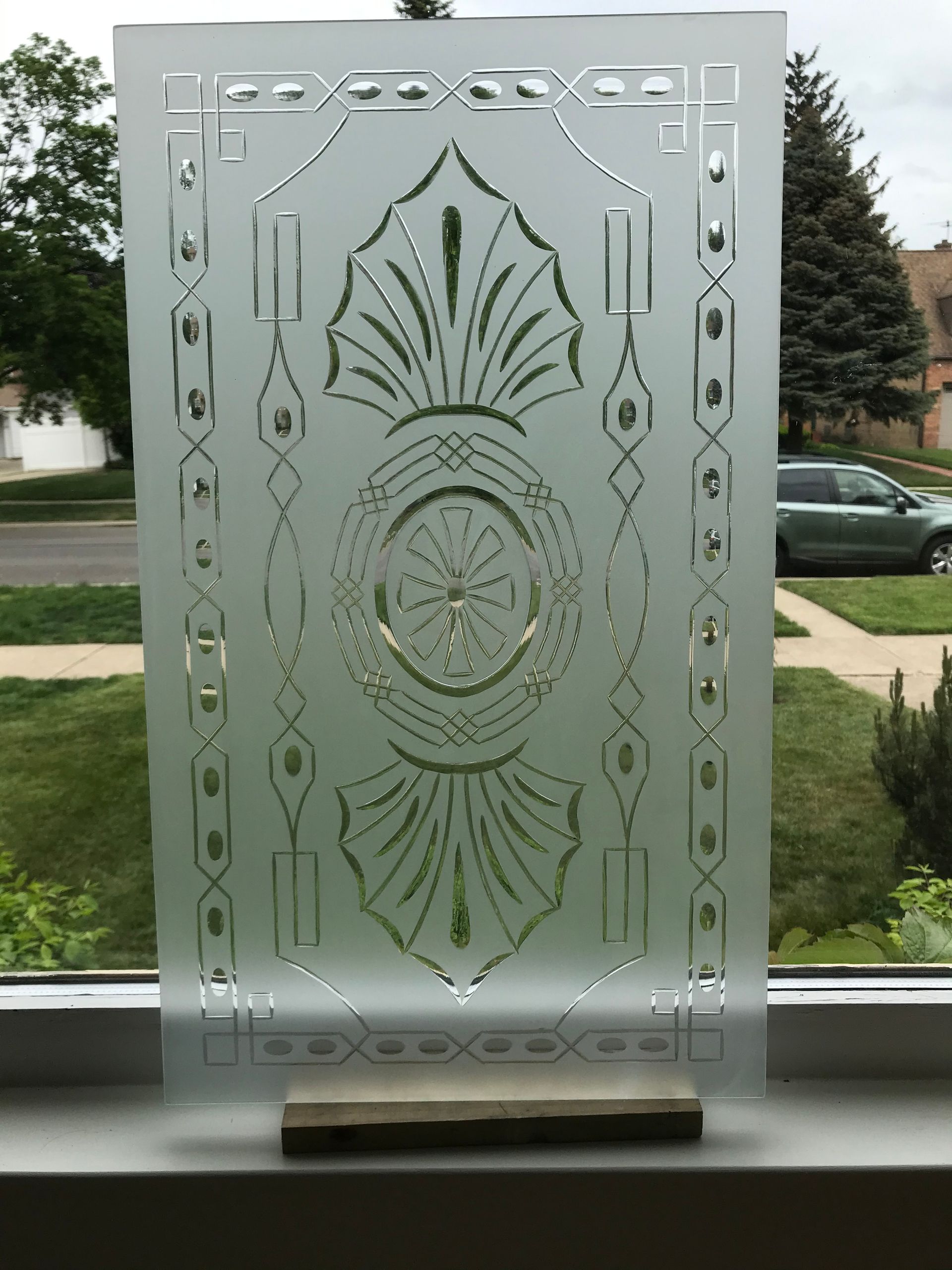
Focus, patience, steadiness—each cut is made on a turning wheel
You might see wheel-engraved designs on Victorian leaded glass panels, old light fixtures or on Venetian mirrors.
This demanding and painstaking work involves cutting designs into the surface of glass with stone wheels of many sizes and shapes. And it’s not just for flat window glass--wheel engraving can be done on flashed or textured glass too. A variety of cuts are possible, although most are V-mitres, and the designs can be polished or left matte.
Our studio does wheel engraving only on pieces that can be hand-held. We are not set up to maneuver larger pieces.